
Risk Evaluation
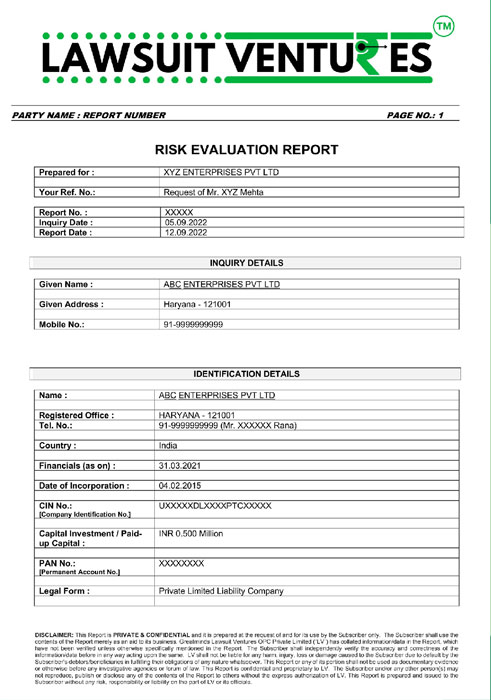
Risk Reports
What Is Risk Evaluation Report
A risk evaluation report for business credibility is a document that assesses and evaluates the risks associated with providing financing or other forms of credit to a business. This report may be prepared by a lender, financial institution, or other party that is considering providing credit to a business and is used to assess the creditworthiness and financial stability of the business.
The risk evaluation report may include a variety of information about the business, including its financial performance, industry, market, and competitive landscape. It may also include information about the business’s management team, ownership structure, and business model.
The report may also include an assessment of the business’s financial health, including an analysis of its financial statements and ratios, such as the debt-to-equity ratio, the current ratio, and the return on equity. The report may also include an assessment of the business’s credit history and any outstanding liabilities or obligations.
A Risk Evaluation Report For Business Credibility May Include A Variety Of Information And Analysis, Including :
- An overview of the business, including its size, industry, products or services, and target market
- A review of the company’s financial performance and stability, including its income, expenses, assets, and liabilities
- An assessment of the company’s management and leadership, including its experience, expertise, and track record
- A review of the company’s legal and regulatory compliance history, including any legal or regulatory actions or investigations
- An assessment of the company’s reputation and standing within its industry and among customers, suppliers, and other stakeholders
- A review of any risks or potential liabilities that may affect the company’s operations or financial stability, such as external market conditions, financial risks, or operational risks
- Recommendations or conclusions based on the analysis, including any potential risks or concerns that should be considered when doing business with or providing support to the company.
A risk evaluation report for business credibility can be an important tool for organizations that are considering doing business with or providing support to another company. It can help to identify and assess potential risks and provide a basis for making informed decisions about the company’s credibility and reliability.
Risk Reports
Here Are Some Points To Consider When Preparing A Risk Evaluation Report For A Business
- Clearly define the scope and purpose of the risk evaluation report.
- Identify the key stakeholders who will be impacted by the report and consider their needs and interests.
- Gather and review relevant financial, operational, and legal data and documents.
- Identify the key risks facing the business, including financial, operational, and legal risks.
- Assess the likelihood and potential impact of each identified risk.
- Determine the appropriate level of risk tolerance for the business.
- Evaluate the effectiveness of the business's current risk management strategies and identify any areas for improvement.
- Identify potential risk mitigation strategies and evaluate their effectiveness and cost.
- Consider the potential impact of external factors, such as market trends, regulatory changes, and economic conditions, on the business's risk profile.
- Analyze the potential risks and benefits of any proposed business activities or initiatives.
- Consider the potential impact of any proposed risk management strategies on the business's operations and financial performance.
- Develop a prioritized list of risks and corresponding risk mitigation strategies.
- Review and update the risk evaluation report on a regular basis to ensure that it remains current and relevant.
- Communicate the results of the risk evaluation report to key stakeholders and ensure that any recommended risk management strategies are implemented.
- Monitor the effectiveness of the risk management strategies and adjust as necessary.
- Use data and analytics to inform the risk evaluation process and to identify trends and patterns.
- Use a consistent and standardized approach for evaluating and managing risks.
- Ensure that the risk evaluation process is transparent and that all relevant data and information is considered.
- Consider the potential impact of cultural and organizational factors on the business's risk profile.
- Ensure that the risk evaluation process is integrated with the overall business strategy and goals.
- Understand the legal and regulatory requirements related to risk management and ensure that the risk evaluation report is compliant.
- Consider the potential impact of technology on the business's risk profile and evaluate the effectiveness of any related risk management strategies.
- Engage with key stakeholders to gain their insights and perspectives on the business's risk profile.
- Use industry benchmarks and best practices to inform the risk evaluation process.
- Consider the potential impact of global events and trends on the business's risk profile.
- Understand the role of insurance in managing business risks and evaluate the effectiveness of the business's insurance coverage.
- Use scenario analysis to assess the potential impact of different risk scenarios on the business.
- Consider the potential impact of reputation risk on the business and evaluate the effectiveness of any related risk management strategies.
